Just about everything in 2020 is different, and this November Election Day won’t be an exception. COVID-19 is causing poll worker shortages in some states, which may result in poll closures and longer lines. Right-wing extremists have promised to mobilize to critical polling sites, with the possible intent to disrupt and intimidate voters.
We want to make sure you know your rights as a voter – rights that many brave activists and organizers fought for in the face of enormous risks and obstacles. This year, every voter must be able to freely vote and every vote must be counted. Here’s what you need to know.
Voting Rights Hotline
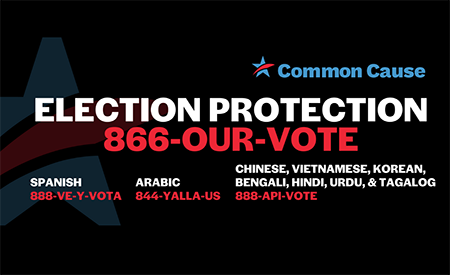
1-866-OUR-VOTE is run by the nonpartisan Election Protection coalition, and is available to every voter in every state to call in with any questions you may have about voting.
Where’s your polling location? What do you need to be able to vote? See something you think might violate election security? Call in to 1-866-OUR-VOTE and speak to a trained lawyer who will answer your
question and connect you to on-the-ground support if you need it.
Hotlines are also available for non-English speakers:
Spanish: 888-VE-Y-VOTA (administered by the NALEO Educational Fund)
Asian Languages: 888-API-VOTE (administered by APIAVote and Asian Americans Advancing Justice AAJC; Bilingual assistance is available in English, Mandarin, Cantonese, Korean, Vietnamese, and Tagalog)
Arabic: 844-YALLA-US (administered by the Arab American Institute)
Voting Rights Basics
- If you are in line to vote, even when the polls close, you have the right to vote. Stay in line!
- Some states, including critical battleground states, have passed ID requirements to be able to vote. Confirm what you need to bring with you to vote beforehand, and find out more at How to Vote.
State-by-State Help
While most states share many regulations, the fight over voter access, enfranchisement, and unique state circumstances means that every state is different. Click on your state below to find what you need.
Quick state links: Arizona, Colorado, Florida, Georgia, Michigan, Minnesota, Nevada, North Carolina, Ohio, Pennsylvania, Virginia, Wisconsin
You can look up voting rights and regulations for any state by clicking here.
Reporting Problems & Voter Intimidation
If you have problems voting or at your polling location, use the hotline 1-866-OUR-VOTE, which will help guide you through the process of reporting problems to state and local election officials.
What is voter intimidation?
Voter intimidation is illegal. It is when someone attempts to sway a voter's choice or prevent them from voting by creating a hostile verbal or physical environment for example, questioning your voter rights by asking personal questions about your
criminal record or citizenship.
Spreading false information about voter requirements, like the ability to speak English, is also considered voter intimidation, according to the American Civil Liberties Union (PDF). You can receive a ballot and election materials in your native
language, according to the U.S. Election Assistance Commission, as protected by the Language Minority Provisions of the Voting Rights Act.
What are the laws against voter intimidation?
Along with voter fraud like double voting and campaign finance crime, voter intimidation is a federal crime. It applies to anyone who "intimidates, threatens, coerces, or attempts to intimidate, threaten, or coerce, any other person for the
purpose of interfering with the right of such other person to vote." If the law is violated, the perpetrator could be found guilty and sentenced up to one year in prison, up to a $1,000 fine, or both.
The National Voter Registration Act of 1993 and the Voting Rights Act of 1965 also prohibit voter intimidation.
How can I report voter intimidation?
If you or someone else is being harassed or threatened at the polls, let a poll worker know. Then call and report it to the Election Protection Hotline (1-866-OUR-VOTE) or the U.S. Department of Justice voting rights hotline (1-800-253-3931). You should also contact your state board of elections. In some cases, a poll worker may call local authorities to remove the individual in question.
Is poll watching considered voter intimidation?
While voter intimidation is illegal, the process of poll watching, also called poll challenging, is legal. A poll watcher is a formal role for a partisan individual whose purpose is to observe a polling place in support of making sure their party has a fair chance, according to the National Conference of State Legislatures.
For example, a poll watcher may closely monitor the election administration and keep track of voter turnout for their parties. They shouldn't, however, try to persuade someone to vote one way or another.
There are necessary qualifications to become a poll watcher, but they vary by state. Legitimate poll watchers are not individuals who simply decide to show up at a polling place. Some states may require poll watchers to be registered voters or a U.S. citizen.
What to Expect on Election Night
Like we said – with just about everything different in 2020, our election isn’t going to be the exception, and that includes when we’ll know the results. Because so many are using absentee and mail-in ballots this year, there may be no clear winner on election night, or even for several days afterward.
Given how important this election is, and the unique circumstances we’re voting under, it makes sense to feel on edge. But we must make sure that every vote is counted and every voice is heard. It’s one of our most important rights as United States citizens, and election officials have a duty to ensure that right is respected. For more information, visit protecttheresults.com.
It may take longer than we’re used to for all the votes to be counted. In some states, absentee and mail-in ballots can’t even be opened until Election Day, and only then can the counting of those begin! The fact is, COVID-19 is going to make the process of counting every ballot and declaring a winner take longer than normal, and we need to adjust our expectations accordingly.
So, just bear all that in mind as we gather together to watch results and await the outcome of this election. We may not know who the winner is before we go to bed on election night and get some much deserved rest. You can follow the Election Night Integrity Project for results that won’t rush to judgement, if you’re interested.