
AT&T and its executives were leading and vocal proponents of the Tax Cut and Jobs Act of 2018, making specific promises on how large corporate tax cuts would benefit American workers. The company's behavior since those tax cuts were enacted has directly contradicted those promises.
AT&T has refused to provide information that would allow its employees to hold the company accountable. Congressional oversight will ensure that AT&T executives are held accountable for their promises.
AT&T reaped an enormous windfall from the Republican tax cuts.
- AT&T profits in 2017 rose to $29.45 billion, up from $12.98 billion the year prior. This reflected a $20 billion boost from the Tax Cuts and Jobs Act in the form of a reduction of future tax liabilities on AT&T’s balance sheet.
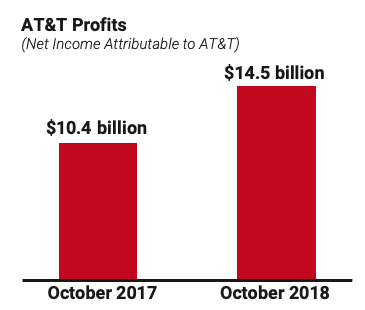 AT&T profits through the first 3 quarters of 2018 were $14.5 billion, an increase of nearly $4 billion over the same period in 2017. Payments to shareholders through dividends and buybacks over that same period account for 72% of these profits.
- AT&T said it expected a $3 billion annual increase in cash profits starting in 2018 as a result of the tax cuts.
- Inadequate disclosures prevent the public from knowing exactly how much less AT&T is paying in taxes on its 2018 income, but AT&T reported substantially less in taxes than prescribed by the new corporate tax rate of 21%, with current federal tax expenses of only 13% of its pre-tax profits.
- Even more concerning, on a cash flow basis, AT&T reported a net tax refund of $354 million in 2018, suggesting that the company paid less than zero in cash taxes since the passage of the Tax Cuts and Jobs Act. While this figure is difficult to interpret without further disclosures by AT&T, it raises serious questions about how much the company truly paid in federal taxes last year.
- Payments to shareholders through dividends and buybacks in 2018 accounted for 72% of AT&T’s net profit.
AT&T CEO Randall Stephenson was a vocal supporter of tax cuts and promised to grow middle class jobs if it passed.
For example, [Stephenson] said AT&T would have to add 7,000 jobs to execute on every $1 billion of capital investment. ‘There are jobs wearing hard hats … to put that capital into the ground or on cell towers’ he said. ‘There are high-paying, really good jobs with great benefits. The correlation is tight — very, very tight.
From my standpoint, the driver of this is the business tax reform… if we get investment going, we get productivity going, we get wage gain going, we invest another billion dollars. Every billion dollars AT&T invests is 7,000 hard hat jobs. These are not entrylevel jobs. These are 7,000 jobs of people putting fiber in the ground, hard hat jobs that make $70,000 to $80,000 per year.
Randall Stephenson hosted an employee town hall event on August 26, 2017 urging AT&T employees to support the tax bill. “Please go out and contact your Congressional representatives and Senate representatives and tell them this is important to you. I think it’s important that we all do that, OK.”
Republican leaders also promised that tax cuts would benefit working people.
On another town hall call for AT&T employees held by Randall Stephenson with Treasury Secretary Steven Mnuchin and Speaker Paul Ryan on December 6th, 2017, Speaker Ryan said “The data tells us over and over again… you cut corporate tax rates and workers benefit. Pay goes up, wages go up, and competition for those wages goes up. That’s what we’re trying to achieve.”
The tax reform issue page of Paul Ryan’s website said that tax cuts would “give a much-needed lift to the economy, create jobs, promote competitiveness, and put an end to the perverse incentive that companies had to offshore jobs and keep profits overseas.”
President Trump estimated that the tax bill “would likely give the typical American household a $4,000 pay raise. Could be a lot more than that, too.”
Instead of creating jobs, AT&T has spent the year since the tax cut reducing employment and seeking cuts to benefits.
 Since the start of 2018, AT&T has cut union jobs by 12,321.
In just the last four months, AT&T has announced closure of 7 call centers:
- In December of 2018, AT&T announced closure of three Midwestern call centers in Appleton, Wisc., Indianapolis, Ind. and Kalamazoo, Mich.
- In January of 2019, AT&T announced closure of a call center in Syracuse, New York.
- In February of 2019, AT&T announced closure of three call centers in Connecticut.
AT&T is currently seeking cuts to health care and job security for 14,000 union members located primarily in the Midwest states.
AT&T’s recent behavior accelerates a long-term trend of jobs cuts.
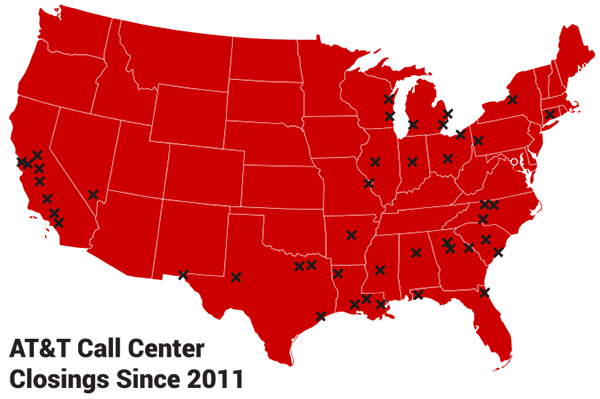
AT&T has cut more than 16,000 call center jobs since 2011 and closed 44 call centers across the country during that period.
In four Midwestern states – Ohio, Michigan, Wisconsin and Indiana – the company has laid off 2,300 workers in just the past three years.
 Many of these middle class jobs are being outsourced and offshored.
AT&T employs a global web of at least 38 third-party call centers across 8 countries to handle customer service, sales and tech support. Countries with AT&T outsourced operations: the Philippines, the Dominican Republic, El Salvador, Colombia, India, Jamaica, Costa Rica, and Canada.
AT&T has also opened two of its own call center in Mexico, which currently employ 2,475 people, and are continuing to grow – drawing customer calls away from U.S. based centers.
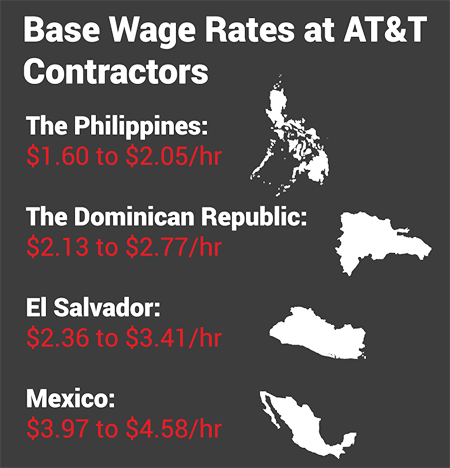
Workers in these offshore call centers earn pennies on the dollar compared to U.S. workers, with hourly pay as low as $1.60 in the Philippines, $2.13 in the Dominican Republic and $2.36 in El Salvador.
AT&T also outsources a large amount of work to domestic call center contractors that pay much lower wages than its in-house, collectively bargaining call centers. Workers for many of AT&T’s major domestic call center vendors report $10 per hour in wages on average.1
In the Midwest, AT&T has eliminated 1,635 technician jobs in the past three years, even as it contracts out all of its network construction, much of its engineering work, and the vast majority of its satellite installation work to contractors. Workers at these contractors report stressful conditions and job instability.2
AT&T savings from the tax cuts and job cuts are going to executives and shareholders
After the passage of tax reform, the company announced plans to pay a bonus of $1,000 to its employees. The bonus amounted to a one-time $200 million expenditure in 2017, or 7% of AT&T’s
expected annual benefit from the tax cuts.
Despite promises to invest more, the company’s 2018 capital expenditures declined by $300 million year over year, and fell by 7% as a share of revenues. Excluding reimbursements from the federal government for AT&T’s build-out of the FirstNet wireless network, investments dropped $1.4 billion and fell by 12% as a share of revenues.
AT&T’s top 5 executives received compensation of $89 million in 2018. CEO Stephenson received $29.1 million in compensation in 2018 and $135 million over the past five years.
During 2018, AT&T distributed $14 billion to shareholders in dividends and stock buybacks. This represents a $1.5 billion dollar increase from 2017. AT&T’s shareholder payments represented 72% of total profits over this period.
AT&T refused to provide information on its tax windfall in contract negotiations. This has prevented its employees from negotiating in an informed manner.
AT&T has stated that information explaining how or whether AT&T plans to use gains from the tax bill to improve compensation for employees or create new job opportunities through investment are not relevant and necessary to negotiations, and the Trump NLRB has refused to require disclosure of this information.
AT&T and its executives were leading and vocal proponents of the Republican tax cut, making specific promises on how large corporate tax cuts would benefit American workers. AT&T’s behavior since those tax cuts were enacted has directly contradicted those promises.
AT&T has refused to provide information that would allow its employees to hold the company accountable. Congressional oversight will ensure that AT&T executives are held to account to their employees.

Tell Congress: Investigate AT&T
- From crowdsourced data via Glassdoor.com for Alorica, Inc. -- https://www.glassdoor.com/Salary/Alorica-Salaries-E17814.htm ; Convergys, Inc.-- https://www.glassdoor.com/Salary/Convergys-Salaries-E8348.htm ; SYKES, Inc., and Teleperformance, Inc. -- https://www.glassdoor.com/Salary/Teleperformance-Salaries-E9779.htm
- See employee reviews for DirectSat -- https://www.indeed.com/cmp/Directsat-USA/reviews ; Mastec -- https://www.indeed.com/cmp/Mastec-Network-Solutions/reviews ; Goodman -- https://www.indeed.com/cmp/Goodman-Networks/reviews