Search News
For the Media
For media inquiries, call CWA Communications at 202-434-1168 or email comms@cwa-union.org. To read about CWA Members, Leadership or Industries, visit our About page.
Panel: Financial Speculation Tax Raises Revenue, Calms Markets
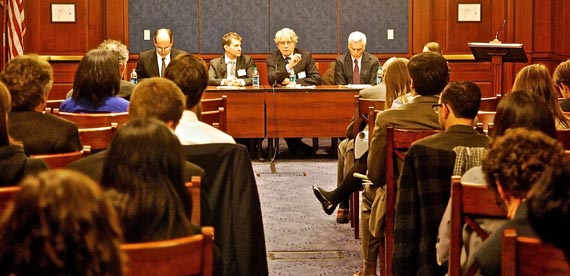
Last Friday, four experts from various sectors briefed congressional staff on the benefits of a Financial Speculation Tax (FST). In particular, they spoke about Sen. Tom Harkin (D-IA) and Rep. Peter DeFazio’s (D-OR) proposed FST with the small, yet impactful rate of 0.03% on all Wall Street trades.
The four-person panel included:
Jared Bernstein – Senior Fellow at Center on Budget and Policy Priorities, former Chief Economist for Vice President Joe Biden
David Borris – Small business owner, Hel’s Kitchen Catering, Chicago/North Shore Illinois
Damon Silvers – Director of Policy and Special Counsel, AFL-CIO
Wallace Turbeville – Senior Fellow at Demos, former Vice President of Goldman Sachs
The panel discussed the dual value of a FST and its ability to raise much-needed tax revenue while simultaneously calming a frenetic marketplace. As Jared Bernstein pointed out, “the Harkin-DeFazio FST raises $350 billion over 10 years. That’s real money.”
This revenue option is being proposed at a time when Washington is struggling to pay its bills. Instead of instituting common sense revenue options, some conservative lawmakers have been calling for cuts to programs like Medicare, Medicaid and Social Security. In the 2012 campaign, Wall Street executives donated heavily to republicans across the country to keep their taxes low and continue leeching off the 99%. They gambled heavily because they want to continue enriching their coffers at the expense of working families. Damon Silvers remarked on Wall Street: “Lloyd Blankfein (CEO of Goldman Sachs) may feel it’s appropriate to take healthcare away from senior citizens rather than institute an FST…but NO one else should.“ Silvers later proclaimed, “It’s profoundly immoral to think about cutting Medicare rather than institute an FST.”
The other beneficial aspect of the FST comes from its application as a “Sin Tax” – a tax that discourages bad behavior (think taxing cigarettes). As high-frequency trading (HFT) has come online in recent years we’ve seen a large boom in the Wall Street volatility. HFT is a system in which Wall Street traders make hundreds - sometimes thousands – of trades per second. They make money by taking advantage of miniscule fluctuations in things like stock prices, and they are largely responsible for exacerbating the Flash Crash of 2010 – a brief market collapse that evaporated millions in a matter of minutes.
These HFT traders produce zero benefit for working Americans and place pensions at risk when their software glitches send markets into a frenzy. Wally Turbeville - a former Wall Street executive himself - noted that “an FST mostly impacts the kind of Wall Street trading that is least productive for our economy.”
By taxing these kinds of dangerous trades we can simultaneously level the playing field for good investors while raising large amounts of revenue for the programs and projects we need most.
Call your members of Congress and tell them to support legislation by Sen. Tom Harkin (S. 1787) and Rep. Peter DeFazio (HR 3313) – The Wall Street Trading and Speculators Tax Act, which proposes a 0.03% tax on stock, bond and derivative trades.
Image provided by Americans for Financial Reform