TABLE OF CONTENTS
| Executive Summary |
| Introduction |
| AT&T’s Gigapower Pitch to Investors |
Gigapower Phase One Updates For Investors
|
| Conclusion: Gigapower Strategy Still a Show Me Story |
Deployment Delays, Missed Targets, and Litigation

| Executive Summary |
| Introduction |
| AT&T’s Gigapower Pitch to Investors |
Gigapower Phase One Updates For Investors
|
| Conclusion: Gigapower Strategy Still a Show Me Story |
The Communications Workers of America (CWA) has found, through an extensive review of the record, that Gigapower and AT&T may be failing to provide transparency to investors and potentially faces existential obstacles to fulfilling its business plan. AT&T has not provided investors with critical metrics like Gigapower’s broadband penetration rates or revenue per customer that it said it would, even after multiple years in business.1 The joint venture is currently embroiled in high price tag litigation with one of its former workforce partners2 and has come under scrutiny from residents and city officials in multiple markets for substandard work practices.3
Company executives initially touted 2025 as a critical deadline for its phase one build.4 While the company has not provided updates regarding this milestone nor offered transparency on its number of fiber passings5 it continues to tout its progress publicly using vague verbiage.6 To gain clarity about the Gigapower’s operations, CWA analyzed the company’s deployments in Arizona, Minnesota, Nevada, and New Mexico through review of corporate disclosures, municipal public records, litigation documents, and field investigations. As a result, CWA found the following:
Overall, CWA believes that in the three years since its launch, AT&T and BlackRock have not proven their Gigapower thesis and investors should be asking hard questions.
In May 2023, AT&T and BlackRock announced the launch of their joint venture Gigapower LLC, a new company intended to deliver access to fiber-optic network infrastructure using a commercial wholesale open access platform.22 With AT&T Fiber serving as Gigapower's anchor tenant,23 the joint venture intends to expand the reach of AT&T Fiber outside AT&T’s traditional service areas with the goal of connecting 1.5 million locations to the network.24
Currently, Gigapower’s network spans nine states: Alabama, Arizona, Florida, Minnesota, Nevada, New Mexico, North Carolina, Pennsylvania, and South Carolina and in November 2025, the company said it had connected over 150 municipalities.25 However, the company has come under scrutiny for failing to disclose metrics regarding how many locations it has connected to fiber,26 calling into question the company’s progress toward meeting its 1.5 million locations target.
Gigapower’s current deployment markets
The Communications Workers of America (CWA), which represents tens of thousands of AT&T’s frontline technicians, has documented Gigapower’s troubled deployments in two previous reports, spotlighting the builds in Mesa27 and Chandler28 Arizona. Both reports found that Gigapower deployments are plagued by severe workforce fragmentation, with Gigapower outsourcing highly technical construction work to dozens of subcontractors, many of which were found to be unlicensed and have poor compliance records. Gigapower deployment activity often resulted in damage to underground utilities and high levels of resident complaints due to poor work quality standards.29
AT&T CEO John Stankey explained the company’s rationale for launching Gigapower by citing the positive performance of AT&T’s existing fiber business – which is directly owned by AT&T, and maintained by CWA-represented frontline technicians.30 Speaking to analysts in May 2023, Stankey said:
If [AT&T in-region fiber] was not performing well, we wouldn't have had the conviction to start the Gigapower venture with BlackRock. I think what we saw within our region, actually, we were so impressed by what we saw, we said, is there an extension of this outside of our region…31
A few months later, the AT&T CFO reiterated “we know how great fiber is in our footprint. We're testing to see how attractive it could be outside of our footprint.”32
To investors, AT&T pitched Gigapower as an “innovative risk-sharing collaboration” allowing them to “prove out the viability of a different investment thesis.”33 Gigapower was supposed to allow AT&T to expand its fiber product beyond its traditional wireline footprint and grow its mobile penetration rates in a capital light manner.34 Another key aspect of the value proposition for investors was the open-access component, creating additional revenue potential.
In January 2023, before Gigapower’s official launch, AT&T CEO John T. Stankey acknowledged that the Gigapower business model was one that the investor base was unaccustomed to, saying:
I'm very mindful of the fact that the Gigapower announcement is a model that the investor base is unfamiliar with. This is something different and something new. And I want to be very sensitive to the fact … .35
To further underscore AT&T’s commitment to transparency with investors regarding Gigapower’s progress Stankey said:
We set up this first tranche to be able to come back to you over the course of 18 months and give you information that raises your confidence and in fact, we are driving the returns on this in the way that we anticipate…I intend to have 12 months of penetration information that I can bring back to you.36
In September 2023, Stankey again reiterated AT&T’s intention to deliver transparency:
[...] we're, of course, tracking our ARPUs, our penetration rates, all those things that we should do. And we'll get into the early part of next year [2024], and I think we'll be in a position to come back and say, "Look, we entered these markets. This was our rate to penetration. These are the ARPUs we're getting. This is what we think the terminal shares are [...]37
Despite these assurances, neither Gigapower nor AT&T have publicly disclosed Gigapower’s fiber connection numbers, revenue per customer, penetration rates, or number of Gigapower customers that are AT&T mobility subscribers. In the first quarter of 2026, AT&T began reporting fiber metrics for its fiber ventures separately from its owned and operated network, but still is not disclosing Gigapower’s fiber connections.38 CWA estimates that Gigapower and AT&T’s ventures with four other commercial open access providers - Boldyn Networks, Digital Infrastructure Group, PRIME FiBER, and Ubiquity - have combined fewer than 430k fiber locations as of the first quarter of 2026.39
This report provides investors with deeper insight into Gigapower’s operational performance at a market level. CWA hopes to encourage investors to push AT&T and Gigapower for more transparency and accountability regarding their progress toward critical buildout targets and also commence a serious discussion about ways to stabilize Gigapower’s workforce to improve operational performance.
During a May 2023 press call, AT&T and BlackRock executives stated that they expected Gigapower’s phase one builds to be completed sometime in 2025.41 Additionally, the expiration date for Gigapower’s Outside Plant Labor and Engineering Agreement with Tilson Technology Management, its initial prime contractor for deployments in Arizona and Nevada, was December 2025.42 On this basis, it appears Gigapower expected to finish phase one by the end of 2025. Yet, the company has not confirmed this critical milestone publicly and raises questions about whether the venture is on track.
After three years in business, Gigapower still has not disclosed its number of fiber locations and industry-watchers have taken note. New Street Research analyst Jonathan Chaplin spoke to the ambiguity surrounding Gigapower’s progress following AT&T’s second quarter 2025 earnings call, stating “[w]e suspect that Gigapower has fallen short of expectations so far. As far as we have seen, the company still isn’t disclosing Gigapower locations, which means they are still too small to matter after over two years of being in business.”43 and a September 2025 article from Telecoms.com called out Gigapower’s lofty claims about its progress, saying “Gigapower's headline claim about ‘accelerating’ its fibre deployment with expansion across six states feels disingenuous; at least, it does without further context, which the company seems unwilling to share.”44
While AT&T and Gigapower executives continue to posture confidently to the press and investors about the joint venture’s progress,45 municipal public records, and legal filings show a joint venture struggling with its workforce model and embroiled in contract litigation with former construction partners.
“We feel pretty good about the 2025 completion date.” |
|---|
By analyzing municipal public records and legal filings, CWA uncovered evidence that suggests Gigapower is failing to meet its on-time build-out targets in Arizona and New Mexico, along with significant time periods of disruption to deployments in Nevada and Minnesota.
Gigapower launched its network in Arizona.46 In September 2022, the company executed a fiber license agreement with the City of Mesa47 and in April 2023, announced that it had connected its first customer in the city.48 Gigapower hired Tilson Technology Management, a telecommunications services firm headquartered in Portland, Maine, to deploy its network in Gilbert and Chandler.49
Gigapower stated, in a September 2025 legal filing in Texas Business Court, that its Arizona builds were off track from the start.50 Gigapower alleged in this filing that Tilson had a target of completing 11,000 living units by the end of 2023 and failed to complete even a single unit that year.51 Gigapower also alleged in the filing that Tilson’s crews dwindled from approximately thirty at inception of the project to less than ten as the project progressed.52
The following year, in 2024, Gigapower’s Chandler build faced multiple shutdowns and pauses of deployment work.53 The legal filing further states that because Gigapower’s deployments in Arizona had a significant backlog of restoration work, city officials in both Chandler and Gilbert started refusing to issue new permits.54
Then, in 2025, the relationship between Gigapower and Tilson further deteriorated. Gigapower dismissed Tilson from the majority of the Arizona builds in early 202555 and on May 19, 2025, Gigapower filed a lawsuit in Arizona state court against Tilson alleging that the company was "holding approximately $3,600,000 worth of property owned by Gigapower hostage" in its leased facility in Chandler, Arizona.56Just days before this lawsuit was filed, a communication from Gigapower’s law firm, Porter Wright Morris & Arthur LLP, to Tilson’s legal department alleged that “Tilson’s current refusal to allow Gigapower to remove its materials from Tilson’s Arizona facility is causing Gigapower irreparable harm in the form of project delays, cost overruns and interference with third-party contracts.”57
According to an ex parte motion for emergency relief, Gigapower stated that it estimated its contractors were “losing approximately 10,000 feet of completed network construction daily”; that its two primary general contractors were “operating at 50% or less of their daily capacity due to a lack of materials”; and that “the lack of materials is causing an economic loss of over $200,000 a day (just to Gigapower's contractors, not to mention the economic loss Gigapower is suffering).” Gigapower went on to state that if its two primary general contractors were unable to work at full capacity that “there is real risk that they may cease work altogether and begin other jobs for Gigapower's competitors” and that “such an outcome would devastate Gigapower's business.”58
On May 27, 2025, Tilson filed a motion to remove Gigapower’s lawsuit to Federal District Court in Arizona60 and on June 2, 2025, the United States District Court for Arizona stayed the claim against Tilson until either the bankruptcy stay was lifted or the bankruptcy court failed to rule on the stay by August 4, 2025.61 Because the US District Court for Arizona stayed Gigapower’s claim, Gigapower was not granted permission to enter Tilson’s leased facility to gain possession of its asserted property.62 As a result, Gigapower’s operations in Arizona may have been significantly slowed down.
Due to the court order preventing Gigapower from recovering its equipment, Gigapower may have foregone deployment of 770,000 feet (over 145 miles) of fiber network construction in Arizona between May 19, 2025, and August 4, 2025, according to its own estimates.63 Additionally, Gigapower’s general contractors stood to potentially suffer an economic loss of at least $16 million over the same timeframe. Gigapower explained that its direct economic loss might have been even larger given that its estimate of daily economic loss did not account for “missed monthly deliverables or lost revenue from sellable LUs (i.e. connection points).”64 While Gigapower told industry news outlet Light Reading that it was able to recover the equipment at some point before July 28, the loss may have been significant.65
According to a Chandler city staffer, after Tilson’s dismissal, Gigapower had some delays with regrouping and hiring new contractors to perform the work as it continues to build out its network in the City. The staffer highlighted the constrained labor market as a potentially significant impediment to Gigapower meeting its projected deployment timelines saying:
“Gigapower initially claimed they would be able to build the whole city in 5 years. I always felt this was optimistic, and informed the City Councilmembers at the Council meeting associated with their License Approval in January 2023 that I would expect a more realistic timeframe to be at least 10 years, given the labor pool available to design and construct these facilities and that multiple providers are competing for that same labor pool [...]”.66
Gigapower’s network deployment in the greater Minneapolis area began in early 202467 and is being led by ITG Communications, a Hendersonville, Tennessee-headquartered construction engineering firm.68 The City of Bloomington issued ten separate SWOs to Gigapower and its contractors between April 2024 and October 2024.69 Gigapower’s SWOs totaled over twelve (12) days of stopped deployment work70 during a critical time period because by mid-November, the City suspends all hard surface core drilling, potholing and excavation activities within the right-of-way for the season.71 In September 2024, ITG requested from the City of Bloomington an extension of work hours, including work authorization for weekend dates, to be able to meet end-of-month deliverables.72 This snapshot of Gigapower’s challenges in just one of a dozen deployment localities in Minnesota raises questions about the overall quality of work carried out in the state.
Gigapower also selected Tilson to build out its network in Las Vegas, Nevada in 2022.73 Gigapower alleged in its September 2025 legal filing in Texas Business Court that in Las Vegas, Tilson did not have field personnel with the necessary experience to do fiber work, which led to machinery being operated incorrectly, causing damage that necessitated extensive restoration work.74
Residents were so upset by negative impacts of Gigapower’s deployment in Las Vegas that they launched a public website tracking the project’s restoration delays and public safety hazards.75



Ultimately, the City of Las Vegas issued a notice of default to Gigapower on January 15, 2025, for violations of its franchise agreement with the city stating that “these infractions cause significant and unreasonable disruption and create a public safety risk.”76 It is unclear how long this notice of default stalled Gigapower’s deployment work in Las Vegas, but in one of Tilson’s bankruptcy filings it refers to the disruption as an “extended pause.”77 Gigapower alleged in a September 2025 court filing that the default notice “imperiled Gigapower’s entire Las Vegas network, seriously jeopardizing Gigapower’s business.”78

After Gigapower’s dismissal of Tilson from the Las Vegas market, it appears that the company is now using TrueNet Communications as its general contractor.80 TrueNet, a Ponte Vedra, Florida-based infrastructure engineering contractor81, is a subsidiary of Fujitsu Limited, the Japanese communications technology equipment and services corporation.82
The City of Albuquerque executed a fiber license agreement with Gigapower in early 2024.83 Gigapower selected Circet USA, a Minnesota-headquartered telecommunications construction contractor, to oversee its build in Albuquerque, New Mexico.84 Within the license agreement, there is a forecast for the number of customer locations that Gigapower was expected to pass by the end of each of the first three years of the term: 30,000 for year one; 90,000 for year two; and 150,000 for year three.85
In response to a CWA public records request to the city inquiring about Gigapower’s deployment status, as of the end of November 2025 – near end of year two – Gigapower had passed approximately 17,000 customer locations.86 Given the forecasts outlined in the license agreement, this suggests that Gigapower had reached only one-fifth (20%) of its forecasted buildout goals.87
Like in the Arizona and Nevada markets, the City of Albuquerque halted Gigapower’s deployment in the interest of public safety. On December 20, 2024, the City of Albuquerque issued a SWO to Gigapower, with the city expressing that it was “seriously concerned about Gigapower’s compliance with the License Agreement.”88 This SWO lasted for two weeks until Gigapower delivered a corrective action plan to the city.89
"I am concerned that if the Arizona Materials are not provided very soon, then Gigapower's network build in Maricopa County will come to a halt, as a consequence of which Gigapower's overall business will suffer significantly." |
|---|
AT&T pitched Gigapower to its investors as a strategic risk-sharing initiative, stretching AT&T’s resources further by bringing in outside financing in the form of BlackRock.90 It is likely that BlackRock, as an asset manager and not a telecommunications provider, bought into the joint venture expecting to benefit from AT&T’s expertise in contractor selection and telecom workforce management.
If Gigapower was looking to recreate the success of AT&T’s in-region fiber builds it overlooked a key input: the workforce deploying the network. AT&T’s in-region fiber builds have significant involvement from thousands of CWA-represented highly trained fiber telecom professionals. Additionally, AT&T is directly involved in overseeing and optimizing its own field operations for in-region builds.91
Gigapower has stated that the success of the joint venture’s business model hinges on the company being the first fiber network in a particular area to ensure adequate subscriber penetration. Many of Gigapower’s deployment markets are highly competitive with multiple companies rushing to be the first fiber provider in a given neighborhood.92 For example, in Mesa, Arizona, Gigapower’s first deployment market, currently has five fiber providers.93 This level of competitiveness requires that internet service providers are able to quickly and properly complete their deployment work.94 Given that contractor performance is critical in a race to the market, Gigapower’s approach to contractor selection and workforce management is curious.
When discussing the selection of Tilson as one of its build partners, Gigapower stated: “Tilson presented itself as a confident and credible partner to build the Las Vegas network. [...] Tilson submitted the low bid for Las Vegas [...]”. Tilson acknowledged that the Gigapower builds in Arizona and Nevada were the company’s largest projects ever.95 Aside from submitting the lowest bid, one is left to wonder what criteria Gigapower is using to assess a contractor’s ability to deliver a high quality, safe, and on-time deployment, considering Tilson’s lack of experience with large projects.
Across multiple markets, even with different prime contractors at the helm, it is clear that Gigapower’s deployments are often plagued with poor coordination between the different layers of contractors, inadequate field supervision, and substandard project management practices to ensure consistent compliance with city codes and regulations.96 Poor contractor performance is likely contributing to unnecessary utility hits and damage in the right-of-way that requires restoration work.97
The repeat appearance of unlicensed and unregistered contractors on the project suggests that Gigapower is failing to properly perform its due diligence even though its Outside Plant Labor and Engineering Agreement states that the supplier is contractually obligated to ensure that the company is aware of all subcontractors working under the agreement before they begin performing work.98
State licensure serves a clear purpose to ensure that contractors are experienced, qualified, and knowledgeable about relevant safety regulations. Failure to verify licensure can lead to a higher risk of substandard work quality and safety issues. Ultimately, by using a lowest-bidder approach, Gigapower deployments can become havens for bad actors. A particularly egregious example of this dynamic is illustrated by an incident in August 2025, in which the New Mexico Department of Justice found that Boreworxx Construction LLC (“Boreworxx”), a subcontractor working on behalf of Gigapower, illegally filed liens on nearly 200 residential properties in Albuquerque “in an attempt to frighten and manipulate homeowners.”105 Boreworxx was not licensed with the New Mexico Regulation and Licensing Department when it began performing work on Gigapower’s deployment.106
Offloading critical field operations work to low-bid contractors may be contributing to Gigapower repeatedly stalled field operations on account of poor-quality fiber installation and restoration work. Combine this with a contractor selection process that seems to lack rigor, it’s unsurprising that the joint venture seems to be struggling with reaching its buildout targets within projected time frames, which may be hindering the company’s ability to be first to market. Failure to connect a single unit a year, as Gigapower alleges that Tilson did in Arizona in 2023,107 is a colossal failure and one that does not fall solely on the hired contractor, but also on Gigapower and its contractor selection process. Multiple missed targets across different markets signals a core issue that CWA believes should be addressed with significant workforce restructuring.
According to Gigapower, the trouble with Tilson began almost immediately.108 Years later, this trouble has now culminated in multiple lawsuits between the parties and Tilson filing for Chapter 11 bankruptcy.
When Tilson sold its lawsuit against Gigapower to Winston I LLC, the sale likely changed the litigation power dynamics between the parties significantly. According to the telecom industry publication Wireless Estimator, “[b]y selling the lawsuit, Tilson monetizes what had become a costly legal fight — while transferring both the risk and potential upside to a buyer whose sole objective now appears to be maximizing recovery…With Tilson no longer involved, industry analysts say Gigapower’s negotiating leverage changes significantly.”118 A telecom restructuring specialist familiar with the case told Wireless Estimator, “A litigation funding entity doesn’t need a future relationship with the defendant…They only need a judgment or settlement.”119 In a March 2026 filing in Texas Business Court, Tilson revealed that Pretium Legal Opportunities Master Fund, LP is financially invested in the outcome of this litigation.120 Pretium closed its inaugural Legal Opportunities Fund in March 2025 with approximately $500 million in equity capital commitments.121
So now, not only is Gigapower entangled in a protracted and costly lawsuit with an opponent likely solely focused on settlement, Tilson’s difficulties may have forced Gigapower to quickly procure and onboard new prime contractors to continue its time-sensitive buildouts in Gilbert, Chandler, and Las Vegas. Identifying and vetting qualified contractors is already difficult given the significant contractor consolidation in the fiber industry, but this becomes even harder when builds are already in progress and deadlines are looming. Gigapower acknowledged this industry constraint in its legal filings saying “there are few contractors in the market able to do the work required for Gigapower's core business.”122
According to a Chandler city staffer, after Gigapower dismissed Tilson from that market, the company did not replace Tilson with a single general contractor, but is instead relying on different contractors for different parts of the build - backbone, fiber-to-the-home, multi-dwelling unit - and those different contractors further subcontract out specialized aspects of the work. Additionally, Gigapower is now directly contracting with a restoration company.123 It appears that, at least in Chandler, Gigapower has moved away from the single general contractor model and that the workforce fragmentation has moved further up the chain. Gigapower is now directly contracting with multiple companies, possibly reflecting the lack of general contractors available to manage these large-scale fiber deployments.
This contractor consolidation is illustrated within Gigapower’s own workforce. In August 2025, Tilson sold all its company assets to ITG Communications – Gigapower’s prime contractor for its Minnesota deployment markets – in a $22 million all-cash offer.124 In July 2025, Circet USA, Gigapower’s prime contractor for its Albuquerque build, acquired Blue Streak Telecommunications LLC,125 Gigapower’s prime contractor for buildouts in multiple Florida markets.126
As such, Gigapower’s ability to maintain positive and productive relationships with major contractors is critical to the success of the joint venture and its future fiber deployment projects. Cultivating these types of relationships starts with Gigapower’s contractor vetting process. While the lowest bid model may seem to be an asset on the front end, it may prove to be a liability to Gigapower’s business if accompanied by poor technician training, insufficient numbers of personnel, substandard work quality, and litigation. Additionally, Gigapower’s brand reputation may suffer if the company is not able to contain its contractor issues. In April 2025, Gigapower sent a letter to Tilson stating that in a meeting with the Town of Gilbert, Arizona one of their representatives was told that subcontractors were directly contacting the Town, including the Mayor, threatening to pull out infrastructure that they had already laid claiming that Tilson had not paid them for work already completed and that “this has reached the zenith of frustration with the Town.”127
While Gigapower has publicly shared its geographic focus areas over the years, the joint venture has experienced additional fits and starts (not shared publicly) that suggest Gigapower is still trying to find its footing. In July 2023, Gigapower executed a fiber license agreement with the City of Omaha, Nebraska.128 Since execution, Gigapower has not filed for any construction permits and seems to have abandoned the locality as a deployment priority.129 In June 2024, according to Phoenix City Council meeting minutes, Gigapower was in discussion with the city to bring fiber to Arizona’s capital.130 By March 2025, Gigapower seemed to have tabled those conversations while Google Fiber signed onto a micro-trench pilot project with the city to launch its fiber network there.131 Additionally, Gigapower was in discussions with the City of Gulf Shores, Alabama, but was never able to come to an agreement for its franchise license and thus no business license was issued.132
Both AT&T and Gigapower stated that the joint venture would pursue grant funding from the federal Infrastructure Act’s Broadband Equity, Access and Deployment (BEAD) program, specifically seeking out locations adjacent to its current build locations.133 As of December 2025, Gigapower has received zero dollars of BEAD funding.134 Given that Gigapower was not transparent about how BEAD funding fit into the joint venture’s overall strategy, it is unclear if failing to secure this public funding will impact Gigapower’s ability to deploy in additional markets and hit its 1.5 million build out target on time.
Since Gigapower’s launch in May 2023, company executives claimed, multiple times, to be in conversation with ISPs to be a part of the network. Finally, in November 2025, Gigapower announced that it piloted an arrangement with Flume, a New York City-based internet service provider,135 to deliver managed Wi-Fi internet services to select apartment and condominium buildings in Mesa, Arizona.136 In February 2026, the company announced its second open access tenant, Dojo Networks.137
For Gigapower to be successful as an open access network there would need to be multiple ISPs on the network in each market. In May 2023, former Gigapower CEO Bill Hogg said to industry outlet Light Reading, “[w]e certainly anticipate that there will be a portfolio of ISPs that we’ll have in [a] particular market”128 and gave further detail in June 2024 saying, “somewhere in that three to five range would be probably the max you would expect to see in a Gigapower market.”139
The slow and small launch of Gigapower’s open access business raises questions about the market for this offering, especially given that, according to Gigapower, the joint venture has connected over 150 municipalities.140 It is unclear if Gigapower’s deployment delays may be hampering the onboarding of additional ISPs at this time.
Since Gigapower has not publicly commented on its phase one strategy or goals since 2023 it is unsurprising that the company has provided even less clarity regarding its plans for phase two, though the company did make significant leadership changes in 2025 and 2026.
In February 2025, Gigapower hired Jeff Seidenfaden as its Chief Revenue Officer.141 In June and July 2025, Gigapower announced two new leadership appointments at the company: Toni Broberg to Vice President of External Affairs to oversee strategic engagement of local, state, and federal stakeholders and support the company’s infrastructure expansion,142 and Donna Rattley Washington as Head of Strategy to oversee Gigapower’s strategic growth, including turning the company’s infrastructure into a diversified revenue machine.143 In November 2025, Gigapower named Franciso Maella as its new Chief Executive Officer144 and in March 2026, selected Dave Dobbin to serve as the company’s Chief Strategy Officer.145
With the 2025 buildout deadline now passed, the company seems to be shifting its focus to a new buildout deadline. Chief Revenue Officer Seidenfaden said in September 2025 that the company “is still on target to finish most of its build by 2027.”146 This moving target is mirrored in the company’s market-level activities. The company continues to enter new markets – signing a new license agreement in Glendale, Arizona, in November 2025147 – even as it has stalled in others like Phoenix and Omaha. 148
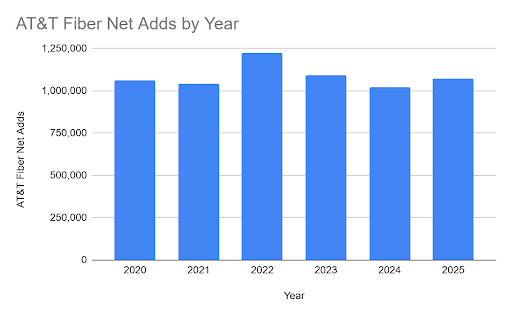
AT&T has said its fiber partnership sales are performing similarly to its in-region business case, but these comments seem to contradict the fiber metrics also presented by the company.150AT&T’s annual fiber net additions for 2024 were down compared to the previous four years, annual fiber net additions for 2025 were down as compared to 2022 and 2023151, and fiber penetration rates have remained flat at 40% for the past eight quarters.152 Over the past ten quarters, between 3Q23 and 4Q25, AT&T has increased its consumer fiber passings by 5.1 million.153 This is nearly 9% fewer fiber locations passed compared to the preceding ten quarters, between 1Q21 and 2Q23 (launch period for Gigapower), during which AT&T passed 5.6 million locations.154
The subcontracted workforce model that was likely intended to protect Gigapower from additional liability and cost may be putting Gigapower’s success at risk. The company’s poor oversight of its contractors may hinder Gigapower’s ability to be first to market because of poor work quality and inefficient deployment practices. Gigapower’s approach has also led to high price tag litigation.
Zooming out, Gigapower’s projected 1.5 million locations are only a 2.5% contribution to AT&T’s total fiber build (60 million locations) through 2030.155 The obstacles that Gigapower seems to be facing when compared to its minimal contribution to AT&T’s overall fiber ambitions calls into question the joint venture’s ultimate value for investors.
CWA believes that after three years since its launch, AT&T has not proven its Gigapower thesis. CWA will continue to track the joint venture’s development under its new leadership and closely follow its deployment efforts against its new 2027 buildout completion timeline. The union continues to call on investors to engage BlackRock and AT&T about the problems with this business model and urge its owners to rethink their race-to-the-bottom approach to deployment.